
Decision-making arrangements establish who may decide, what they need to consider, how the decision is made, and what follows from it. These arrangements affect the quality of decisions.
Use the guide below to design decision-making arrangements or review particular decisions to ensure their quality. The map shows the roles, bodies, and communication channels through which those arrangements would operate. You can also start with the types of decisions you want to make and identify the arrangements needed to support them.
The requirements below concern the decision, the information supporting it, and the arrangements for carrying it out. How you apply them should reflect the kind of decision, its significance, and the stage at which it is being considered. You could adapt the list to suit a particular organisation’s circumstances.
The decision falls within the decision-maker’s power and authority.
Identify the instruments or previous decisions that establish the decision-maker’s authority. Also identify the decision-maker’s assigned responsibilities and the applicable procedural conditions.
Establish how each requirement affects the validity of the decision or the assessment of the decision-maker’s conduct.
The matter warrants this decision-maker’s consideration.
Explain its relationship to the organisation’s purposes, commitments, or agreed direction, and the significance of its intended effects.
The decision is sought when it can inform action, taking account of deadlines, risks, and dependencies.
Obtain required approval before taking action or making commitments that depend on it.
Identify who prepared and supports the proposal.
Give reasons for it, explain the arguments for and against it, and identify favourable and adverse effects on those concerned.
Provide accurate and checked information sufficient to assess the proposal, including its expected outcomes, implications, risks, and effects on existing arrangements.
Make material uncertainties apparent.
Define the available options and present the information needed to decide in a usable form.
Put the decision sought and the main considerations where they can be readily found.
Keep supporting information available for further examination.
State the intended result and how its achievement will be assessed.
Establish how the decision will be carried out: what must happen, who is responsible, when action is required, and what needs to return for review or further decision.
The proposal is ready for the decision being sought.
Complete the consultation, advice, endorsement, approval, or other steps required at this stage.
Keep evidence of the information relied on and the steps completed, including consultation, advice, and prior approvals.
Record the decision and any conditions attached to it.
You can combine this guide with the model for assessing the application of a governance arrangement. When examining how a decision is made, establish whether the procedure exists and is accepted. Check whether the people and circumstances are appropriate and whether the procedure was carried out correctly and completely. Identify any required attitudes and subsequent conduct. Consider separately what was accomplished, whether the requirements were met, and how serious any failure was.
A decision-making map can help distinguish:
- Roles: the capacities in which people propose, advise, decide, act, or report.
- Bodies: committees or other bodies with specified responsibilities and powers.
- Communication channels: submissions, briefing notes, meetings, and other means through which contributions reach their recipients.
For each connection in the map, identify what is being provided, to whom, through which channel, and for what purpose. Advice, recommendation, endorsement, approval, and noting each require their own description.
The map shows how advice, proposals, and recommendations reach the decision-maker, how the decision reaches those responsible for carrying it out, and how they report back. Select the routes that apply to the particular decision.
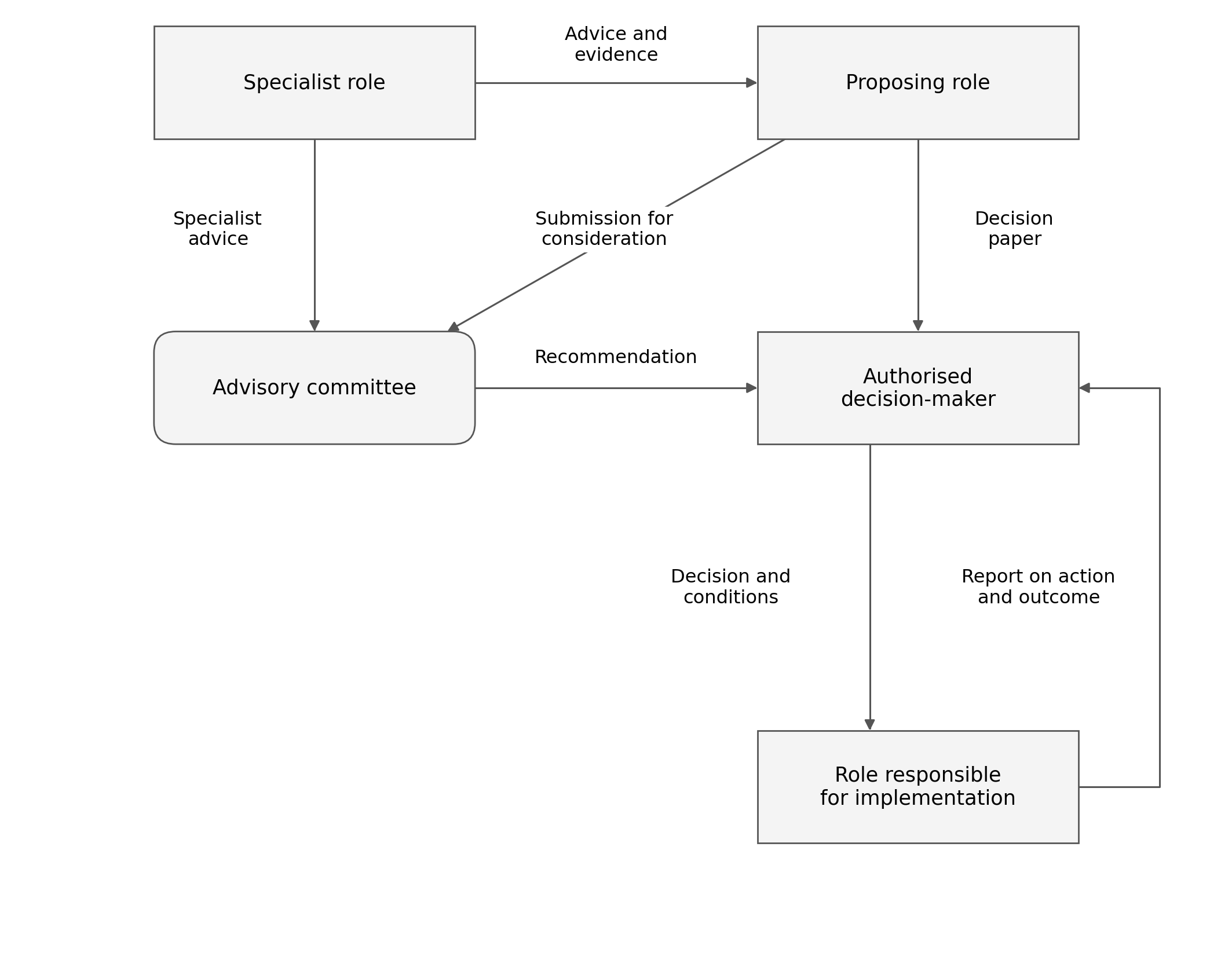
The decision-maker may be an individual or a collective body. Where several approvals or consents are required, identify each as a distinct decision and show its relationship to the others.
For each contribution or act, identify what the person or body is accountable for and to whom they are accountable.

Plain Governance, developed by Dr Julien Maréchal. © 2026 The Governance Practice.
Original materials: CC BY 4.0. Source. Scope and attribution.
Logos, third-party material, and website software are excluded.